Understanding Carbon Monoxide(CO): Pollution, Health Impacts, Safety Limits And Industrial Solutions.

Pollution, especially industrial pollution, is increasing day by day, and the air quality is decreasing as a result. When we talk about air pollution, there are various pollutants like CO2, SO2, and VOC among them. CO, or carbon monoxide,(CO Pollution) is one of them. In this article, we will look into carbon monoxide, its impact on the industrial work environment, health impacts, safety limits, and the solutions required to limit exposure for industry.

What is carbon monoxide (CO)?- CO Pollution

Carbon monoxide (CO) is a poisonous, flammable gas that is colorless, odorless, and tasteless. It is slightly less dense than air and is soluble in water. 

How Carbon Monoxide is Generated:

Carbon monoxide (CO) generated by natural gas, wood, or gasoline is burned incompletely.

Carbon Monoxide (CO) Sources:

Natural Sources:

Natural sources of carbon monoxide include the following:

  • Volcanoes
  • Natural Gas
  • Forest Fires
  • Lighting

Man-made sources

Man-made or artificial sources of carbon monoxide (CO) are as follows:

  • Vehicle Emissions
  • Barbeques
  • Wood stoves
  • Gas and water heaters
  • Gas stoves
  • Fuel-fired heaters
  • Fireplaces
  • Gas dryers

Industrial Sources

  • Metal manufacturing
  • Electricity supply
  • Mining metal, ore, and coal
  • Food manufacturing
  • Extracting oil and gas from land or sea
  • Production of chemicals
  • Cement, lime, plaster 
  • Concrete manufacturing 
  •  Petroleum refining

Industrial Processes That Generate CO

  • Laser Cutting
  • Soldering 
  • Plasma Cutting
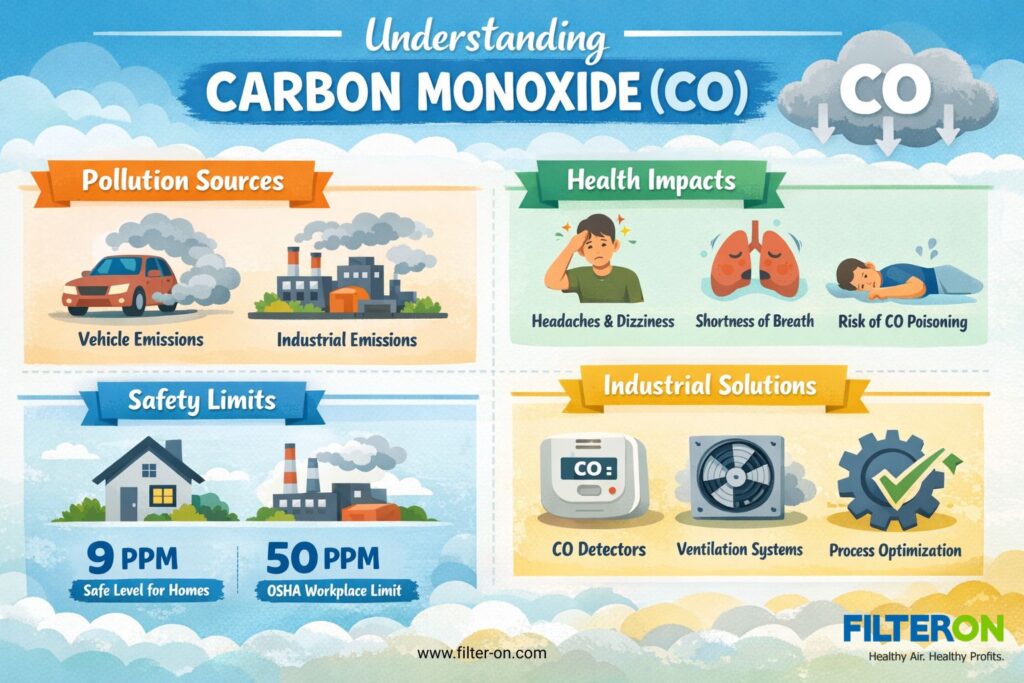
Infographic explaining carbon monoxide (CO) pollution, health impacts, safety limits, and industrial solutions.

Health Impacts of Carbon Monoxide(CO Pollution):

Carbon monoxide has Severe health impacts are on industrial workers and all people who are in constant contact with fossil fuel burning and processes that produce carbon monoxide, which are listed above. Some of the important health impacts are listed below:

Short-term:
exposure from breathing carbon monoxide can cause:

  • Headache
  • Nausea and vomiting
  • Blurred vision
  • Confusion
  • Dizziness
  • Chest pain
  • Weakness
  • Difficulty breathing
  • Damage to the heart and brain
  • Unconsciousness

Breathing in high amounts of carbon monoxide is life-threatening.

Long-term:
Exposure to high carbon monoxide levels can cause:

  • Miscarriage
  • Damage to a developing fetus
  • Seizures
  • Coma
  • Heart failure

Safety Limits for Carbon Monoxide (CO Pollution):

The Occupational Safety and Health Administration (OSHA) states that the permissible exposure limit (PEL) for carbon monoxide (CO) is 50 parts per million (ppm). This means that the average concentration of CO in the air over an 8-hour period should not exceed 50 ppm. The 8-hour PEL for CO in maritime operations is also 50 ppm.

You can read various safety limits for CO here.

In India, the Central Pollution Control Board (CPCB) has also set some norms about carbon monoxide exposure. These are as follows:

For industries, the 8-hour PEL of CPCB for industrial, residential, rural, and other areas is 02 mg/m3, and for 1 hour, PEL is 04 mg/m3. The 8-hour PEL of the conditional and sensitivity areas declared by the central government . is 02 mg/m3, and the 1-hour PEL is 04 mg/m3.

Solutions for Carbon Monoxide (CO Pollution) Exposure in Industries:

To limit the exposure of carbon monoxide (CO) in industries and mitigate the risks for industrial workers.

  • Measurement through CO sensors: Industries should monitor and measure carbon monoxide (CO) by using carbon monoxide monitoring sensors, through which they can monitor, control, and measure carbon monoxide exposure.
  • Using extraction solutions: Industries must use extraction solutions to control CO exposure in the industrial environment. Solutions such as Filter on Soldering Fumes Extraction Solutions, Filter on Laser Fumes Extraction Solutions, and Filter on Plasma Cutting Fumes Extraction Solutions are for controlling soldering fumes, laser cutting fumes, and plasma cutting fumes exposure, which also results in CO exposure.
  • Using ventilation solutions: Industries must use ventilation solutions such as LEV (local exhaust ventilation) for a clean air environment in the workplace. 
  • No Vehicle Use for Walking Distance:  Everyone should follow the no vehicle use policy for walking distance, which can reduce CO in the environment. Making such little effort can create a big impact on the environment in the long run, which is the best initiative for our long-term goal, “Mission Zero Pollution.” 
Visit  blogs to learn more about the critical features of clean air system design and air pollution control systems created by Filter On India.

Filter On India has been working towards “Mission Zero Pollution” for the last 40+ years as a clean air solutions partner for industries. We specialize and have expertise in welding fumes, oil mist, coolant mist, dust collection, soldering, laser marking, laser cutting, plasma cutting, fumes in fastener manufacturing, ball point tip manufacturing, oil quenching, kitchen fumes, etc. Filter On has 70+ clean air solutions, so you can contact us for more information about our solutions. You can reach us through the web or visit us at our corporate office at Pune, or mail us at : marketing@filter-on.com

Facebook
Twitter
LinkedIn