

Manual welding is an integral part of almost every manufacturing setup. Unlike robotic welding, which requires a higher investment and budget, manual welding is cost-effective and fits well within most operational budgets. That is why manual welding stations are present in nearly every manufacturing facility. However, an important question remains: what is the status of fume extraction at these manual welding stations?
Manual welding includes various welding processes such as MIG welding, Stick welding, TIG welding, Plasma Arc welding, Electron Beam welding, and Laser welding. Each of these welding types generates fumes with different characteristics and therefore requires a suitable fume extraction system based on the welding process and several operational parameters. These parameters will be discussed one by one, starting with the potential dangers associated with manual welding.
The risks associated with manual welding can be broadly categorized into immediate hazards and long-term health consequences, as outlined below.
Manual welding produces a complex mixture of toxic metal particles and hazardous gases.
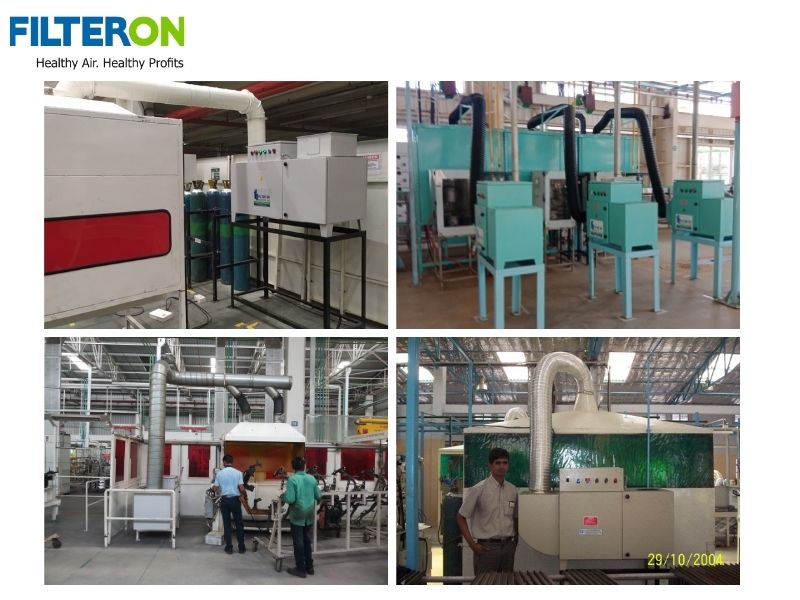
The working principle of a manual welding fume extraction system involves capturing fumes directly at the source. A hood is installed above or beside the welding station and connected to the fume extractor through ducting. Welding fumes are drawn through the hood and ducts into the filtration unit, where fine particulate matter is captured. Clean air is then discharged through the extractor fan back into the workplace or outside, depending on the system design.
A properly engineered fume extraction system is essential to capture hazardous fumes directly at the source before they disperse into the work environment.
Equipment such as a fume collector, fume extractor, or fumes extractor plays a key role in improving workplace safety and ensuring compliance with occupational health standards.
For applications involving gaseous pollutants, a fume scrubber system is commonly used to neutralize harmful vapors before air is released or recirculated.
Welding operations generate toxic metal fumes that require effective source capture. A dedicated fume extractor for welding or fume extractor welding setup helps control exposure in manual and automated welding stations.
A complete welding fume extraction system or welding exhaust system is designed based on welding type, enclosure conditions, and duty cycle.
Proper welding fume exhaust not only improves air quality but also supports regulatory compliance, while system selection from certified welding fume extractor manufacturers ensures reliability and long-term performance.
The welding fume extractor price typically depends on airflow capacity, filtration efficiency, and system configuration.
When selecting a manual welding fume extraction system, several important factors must be considered.
Is fume extraction mandatory for manual welding?
Yes. Safety authorities such as OSHA, HSE, CPCB, and EPA mandate the use of appropriate fume extraction or respiratory controls during manual welding to reduce exposure to hazardous fumes and protect worker health.
Which fume extraction system is best for manual welding booths?
The ideal system depends on factors such as the welding process, number of welding stations, enclosure design, and airflow requirements. Common solutions include extraction arms, welding hoods, and downdraft tables that capture fumes directly at the source.
Are welding fumes harmful during short welding operations?
Yes. Even short-term exposure can cause metal fume fever, respiratory irritation, and eye discomfort. Repeated exposure without proper fume control can result in serious long-term health issues.
Can one fume extractor serve multiple manual welding stations?
Yes. A centralized fume extraction system can serve multiple manual welding stations if it is properly designed with adequate airflow capacity, balanced ducting, and effective fume capture at each station.
Visit blogs to learn more about the critical features of clean air system design and air pollution control systems created by Filter On India.