Categories
Blogs

Understanding Sulphur Dioxide(SO2):Sources Of Pollution, Health Impact, Knowing Safety Limits and Solutions

Understanding Sulphur Dioxide(SO2):Sources Of Pollution, Health Impact, Knowing Safety Limits and Solutions.

Sulphur Dioxide (SO2) is one of the most significant primary air pollutants after carbon dioxide and nitrogen oxides. This harmful gas plays a major role in industrial air pollution and poses serious risks to workers’ health and workplace safety. In this article, we explore how SO2 becomes a threat in industrial environments, its health impact on workers, the safety limits required to control SO2 exposure, and the key government regulations designed to reduce the risks associated with Sulphur Dioxide in industries.

What is sulfur dioxide(SO2)?

Sulfur dioxide (SO2) is a colorless, toxic gas with a strong, choking odor. It's a member of the sulfur oxide (SOX) family of chemicals, which are made up of sulfur and oxygen.

Sulfur Dioxide (SO2) as a Pollutant

Sulfur dioxide has various sources of pollution; some of the sources are as follows:

Natural Sources

Sulfur dioxide is naturally generated through

Volcanic Eruptions

Artificial Sources

There are two types of artificial sources of SO2.

  • Industrial Sources
  • Other Sources

In industries, SO2 is generated through petroleum refineries, cement manufacturing, paper pulp manufacturing, and metal smelting and processing facilities.

Other sources of SO2 include locomotives, large ships, and some non-road diesel equipment that currently burns high-sulfur fuel and releases sulfur dioxide into the air.

Burning fossil fuels (coal and oil) for domestic heating is also a source of SO2

Highest Concentration Of SO2 In The World –

In the world scenario the highest concentration of SO2 is from our country India, then on the second spot is Russia and Third is China.:

India as the largest emitter of SO2 in the world, contributing more than 21% of global emissions mainly coming from coal-based electricity generation.
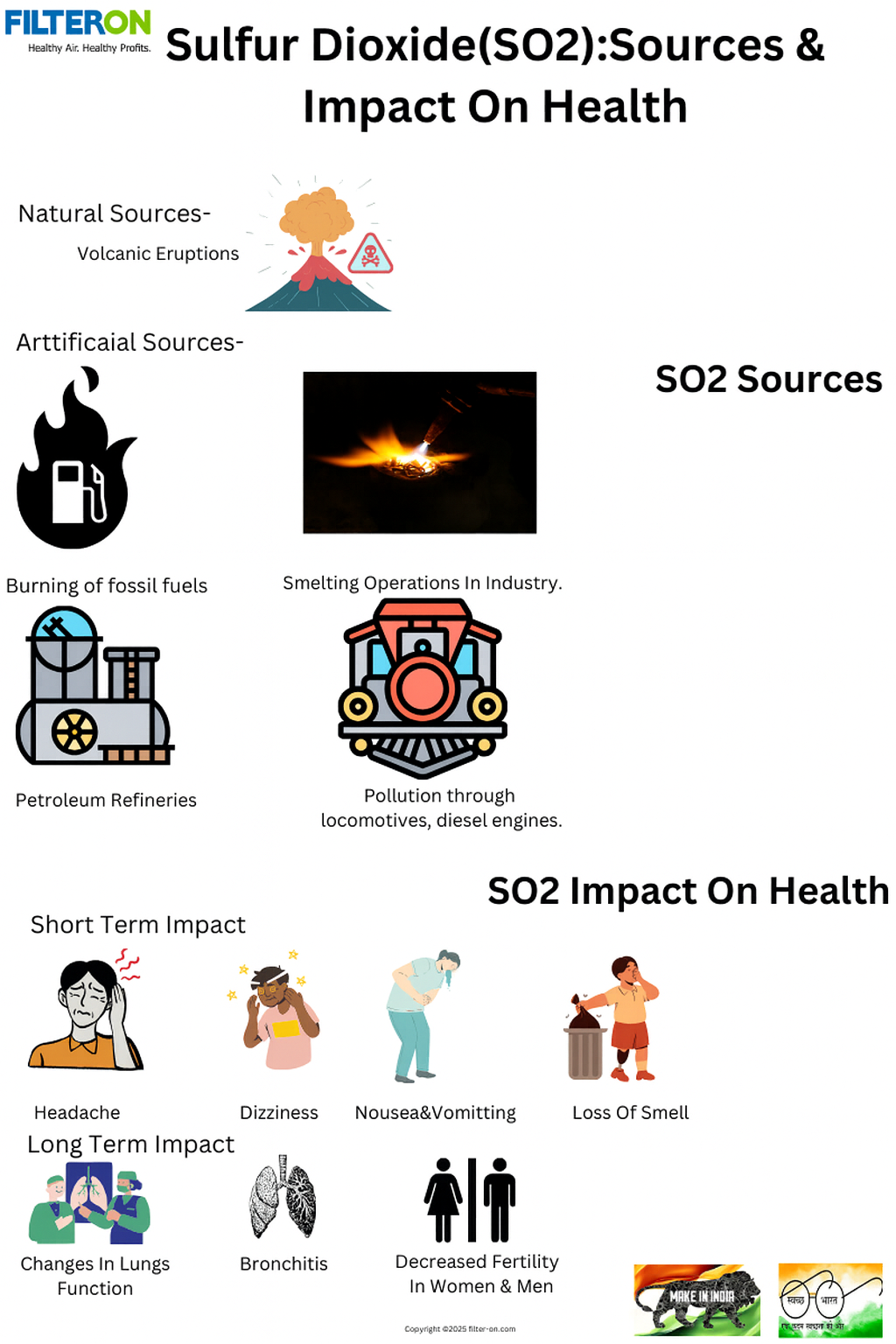
Sulphur dioxide(SO2) sources and health impact

How are you exposed to Sulphur dioxide(SO2)?

You can be exposed to Sulphur dioxide(SO2) by breathing it in the air or getting it on your skin. People who live near industrial sources of sulfur dioxide may be exposed to it in the air. You are most likely to be exposed if you work in industries where SO2 is produced, such as copper smelting or power plants, or where it is used in the production of sulfuric acid, paper, food preservatives, or fertilizers. People with malfunctioning appliances or chimneys in their homes may also be exposed to sulfur dioxide.

Most SO2 exposures are caused by people breathing contaminated outdoor air.

SO2 Impact on Health:

The impact of SO2 on health consists of short-term and long-term impacts.

Short-Term Impact of SO2 on Health:
Exposure from breathing sulfur dioxide can cause:

  • Burning of the nose, throat, and lungs
  • Difficulty breathing
  • Loss of smell
  • Headaches and dizziness
  • Nausea and vomiting
  • Harm to the respiratory system: As an irritant, sulfur dioxide can affect lung function and cause and worsen respiratory diseases in humans and animals.

Exposure to very high levels of sulfur dioxide can be life-threatening.

Touching liquid sulfur dioxide can cause:

  • Frostbite
  • Irritation of the eyes:

Long-Term Impact of SO2 on Health:
Long-term exposure to sulfur dioxide can cause:

  • Changes in lung function

SO2 emissions that lead to high concentrations of SO2 in the air generally also lead to the formation of other sulfur oxides (SOx). SOx can react with other compounds in the atmosphere to form small particles. These particles contribute to particulate matter (PM) pollution. Small particles may penetrate deeply into the lungs, and in sufficient quantity, they can contribute to health problems.

  • Bronchitis and shortness of breath

People with asthma may be sensitive to changes in respiratory effects due to SO2 exposure at even low concentrations. Sulfur dioxide is not classified as a human carcinogen (it has not been shown to cause cancer in humans).

  • Decreased fertility in women and men:

 Continuous inhalation of SO2 affects fertility rates in women and men.

Solutions for SO2 Exposure at Industries

Safety measures taken by industries Include the following:

Use ventilation systems.

Use of ventilation systems like LEV (local exhaust ventilation) can reduce the exposure to SO2 to some extent, which leads to an increase in air flow capacity in the work environment, which is very important for workers health.

Use of Extraction Systems:

Using extraction systems for air pollution control is the best solution to protect workers from high exposure to SO2-like pollutants, such as  Filter On  welding fume extraction systems, oil mist collectors, and dust collection systems will be very beneficial for industries to reduce the risk of SO2-like pollutants on workers health.

Use the government guidelines.

Using and following the government guidelines from time to time will surely reduce the exposure of SO2 in industries, and it will have a positive impact on society.

Here are some safety precautions for SO2 exposure, including:

  • Using personal protective equipment as required
  • Increasing ventilation in the area or moving a leaking container to a well-ventilated and secure area
  • Stopping or reducing the leak if it is safe to do so
  • Knocking down gas with fog or a fine water spray

Safety limits for SO2 exposure.

As per OSHA, the permissible safety limits for SO2 exposure are as follows:
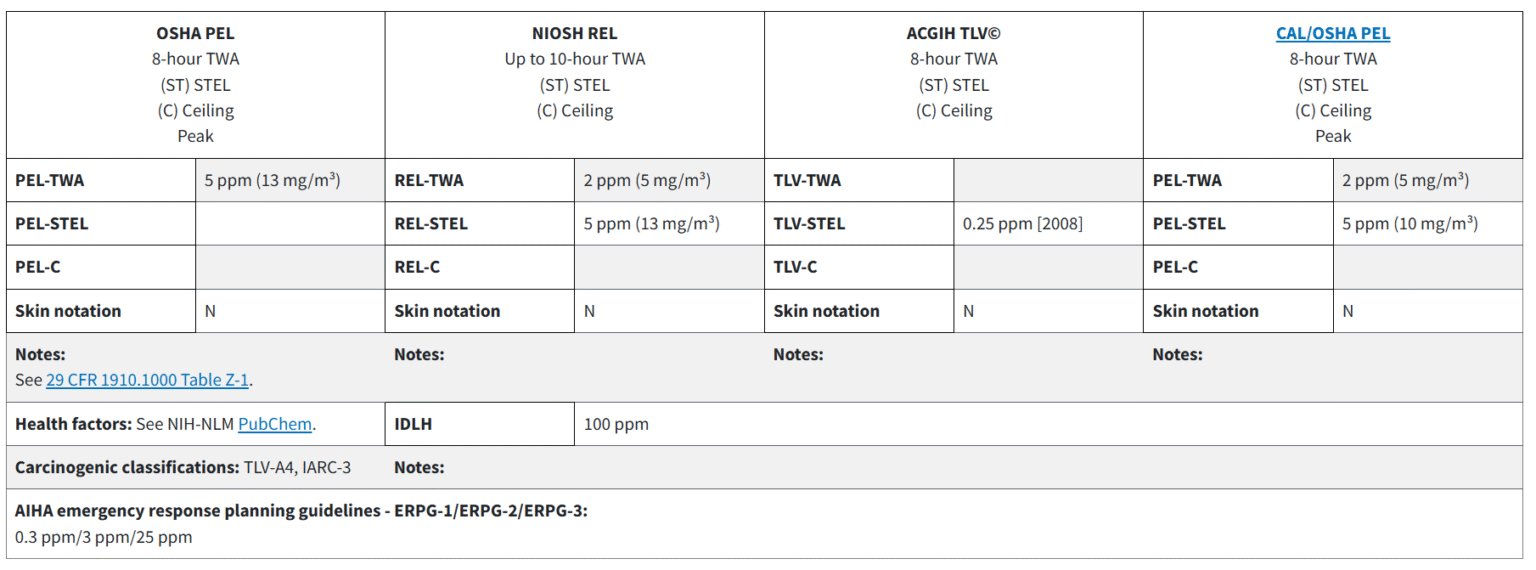
SO2 OSHA Limits

In India, as per CPCB-Central Pollution Control Board Of Regulation the SO2 Exposure limits are as follows-
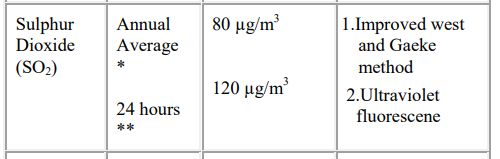
CPCB SO2 Exposure Limits

Visit  blogs to learn more about the critical features of clean air system design and air pollution control systems created by Filter On India.
Filter On India has been working towards “Mission Zero Pollution” for the last 40+ years as a clean air solutions partner for industries. We specialize and have expertise in welding fumes, oil mist, coolant mist, dust collection, soldering, laser marking, laser cutting, plasma cutting, fumes in fastener manufacturing, ball point tip manufacturing, oil quenching, kitchen fumes, etc. Filter On has 70+ clean air solutions, so you can contact us for more information about our solutions. You can reach us through the web or visit us at our corporate office at Pune, or mail us at : marketing@filter-on.com

Facebook
Twitter
LinkedIn
Categories
Blogs

Understanding CO2: Pollution, Impact And Proactive Solutions.

Understanding CO2: Pollution, Impact And Proactive Solutions.

In today’s world, air pollution is a huge and serious issue. Alarming sea levels and the effects of global warming are seen everywhere. Carbon dioxide (CO2) is a major pollutant among all pollutants. It’s effects on the health and environment are problematic in nature. When we talk about industrial pollution, it is one of the problems as well, so in this article, we’ll discuss CO2 and the role of CO2 in air pollution. Its impact on industrial workers as well as industries, the environment, preventive measures, compliance, etc.

What is CO2?

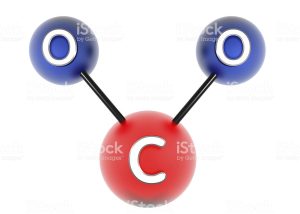
Carbon dioxide is a chemical compound with the chemical formula CO2. It is made up of molecules that each have one carbon atom covalently double-bonded to two oxygen atoms.

CO2 as a Pollutant

Carbon dioxide is a major pollutant in air pollution. When talking about air pollution, this greenhouse gas has a major portion in it.

Sources of CO2 Pollution in the Industrial Indoor Work Environment

There are numerous sources of CO2 pollution. We are here discussing CO2 and its effects on the workplace environment and workers health.

There are mainly four types of sources of CO2 often seen in the indoor industrial environment.

Respiration from employees.
Burning of fuels
Industrial Operations
Goods Transportation

Respiration from Employees

In a close work environment, mostly in offices, CO2 is mostly generated by respiration among the employees.

Burning of Fossil Fuels

The burning of fossil fuels for the operation of machinery is another way of generating CO2, and if there is low ventilation, the CO2 can be hazardous to the workers.

Industrial Operations-

Industrial operations, i.e., processes like welding, cutting, and brazing of metals, generate CO2 because fumes from these processes are more hazardous to the health of the workers. These processes produce more CO2, and without proper ventilation and fume collection systems, in most of the industries, workers face various health issues due to CO2 pollution.

Goods Movement-

Goods movement or transportation in a closed environment where trucks and cranes are used for goods movement in large premises generates CO2 generated through vehicles, which is harmful for the workers and employees who used to work there.

Thus, CO2 as a pollutant plays a major role in industrial indoor air pollution.

Impact of Carbon Dioxide (CO2) on Health:
Short-Term Health Effects:
Exposure to high carbon dioxide levels can cause:

Suffocation by displacement of air: The suffocation-exposed person has no warning and cannot sense the oxygen level is too low, so it leads to a breathing issue.

Incapacitation and unconsciousness: At high concentrations, carbon dioxide can cause unconsciousness and respiratory arrest within one minute.

Headaches: Excessive amounts of carbon dioxide inhalation can cause headaches.

Vertigo and double vision: Carbon dioxide exposure can cause vertigo and double vision. At high levels of exposure, the carbon dioxide itself can cause vertigo, dizziness, nausea, and other symptoms like double vision.

Inability to concentrate: High exposure levels of CO2 lead to concentration problems while working; suffocating environments can cause an inability to concentrate, which results in productivity loss.

Tinnitus: According to one study, chronic tinnitus is related to multisensory environmental hypersensitivity, including CO2 thresholds. Another study reports that tinnitus has been reported in hearing loss secondary to carbon monoxide poisoning.

Seizures: Carbon dioxide (CO2) can increase brain excitability, which can lead to spontaneous seizures.

Breathing in high amounts of carbon dioxide may be life-threatening.

Touching liquid carbon dioxide can cause frostbite or blisters.

Carbon dioxide can cause frostbite when anyone is in contact with solid CO2 (dry ice) and vapors off-gassing from dry ice.

These frostbite blisters on the skin may begin to feel warm—a sign of serious skin involvement. If you treat frostbite with rewarming at this stage, the surface of the skin may appear mottled. And you may notice stinging, burning, and swelling. A fluid-filled blister may appear 12 to 36 hours after rewarming the skin.

Long-Term Health Effects: Prolonged exposure to carbon dioxide may cause:

Changes in bone calcium-induced respiratory acidosis induced by an elevated carbon dioxide (CO2) environment should provoke hypercalciuria with related total body and subsequent bone calcium losses. often leads to osteoporosis.

Changes in body metabolism: In the human body, carbon dioxide is formed intracellularly as a byproduct of metabolism.

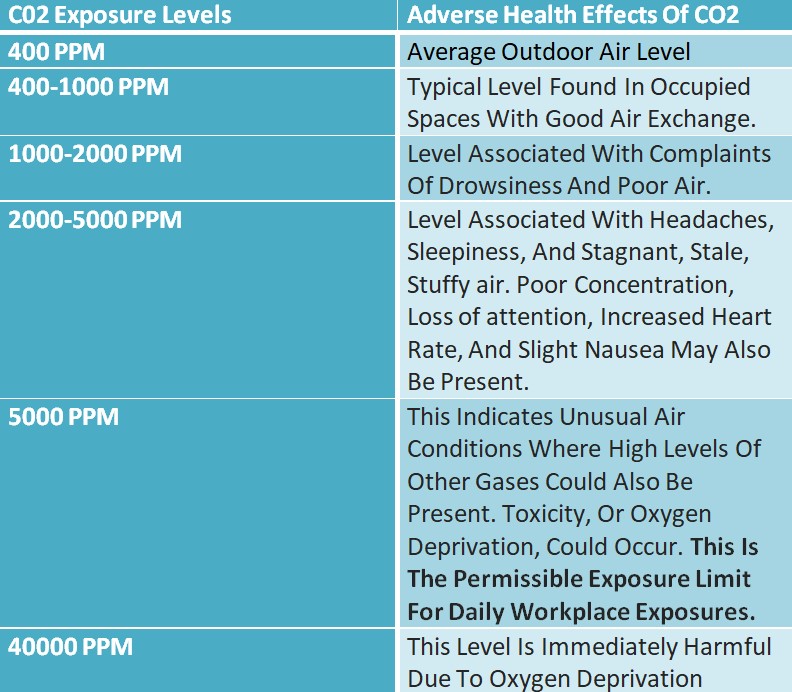
Levels of CO2 Exposure to Health

Safe exposure limits for carbon dioxide (CO2):

According to the US Health Department, carbon dioxide is not generally found at hazardous levels in indoor environments. The MNDOLI has set workplace safety standards of 10,000 ppm for an 8-hour period and 30,000 ppm for a 15-minute period. This means the average concentration over an 8-hour period should not exceed 10,000 ppm, and the average concentration over a 15-minute period should not exceed 30,000 ppm. It is unusual to find such continuously high levels indoors and extremely rare in non-industrial workplaces. These standards were developed for healthy working adults and may not be appropriate for sensitive populations, such as children and the elderly. MDH is not aware of lower standards developed for the general public that would be protective of sensitive individuals.

In the Indian context, the exposure limits for CO2 are as follows: CO2 < 1000 PPM (home) < 5000 PPM (workplace-short duration).

Proactive Solutions for CO2 Emissions in Industries


Measure your CO2 levels in industries.
You can measure CO2 levels at your workplace by using a CO2 sensor. The most common type of sensor is the non-dispersive infrared (NDIR) sensor. This sensor measures infrared light in a sample of air. NDIR sensors are popular because they have a long life, are fast, and have low cross-sensitivity to other gases. They can measure CO2 concentrations with high accuracy across a wide range of volumes. The measuring unit detects the CO2 concentration and converts it into a digital display.

Use renewable energy solutions.
You can use renewable energy solutions for CO2 reduction from traditional energy sources. Sources like solar energy and wind energy can reduce the carbon footprint and make industries self-sustainable in the long run.
Use ventilation solutions.
Using ventilation solutions such as local exhaust ventilation, an adequate amount of air flow through windows, and proper placement of machines that are responsible for CO2 generation with effective measures can reduce the carbon footprint in industries.

Use extraction solutions.
Clean air solutions like fume extraction, oil/mist collectors, dust collection systems, and laser cutting extraction solutions can reduce CO2 exposure in industries, which helps workers get proper ventilation at work and can have a positive impact on their productivity.

Filter On India has been working towards “Mission Zero Pollution” for the last 40+ years as a clean air solutions partner for industries. Filter On has 70+ clean air solutions, so you can contact us for more information about our solutions. You can reach us through the web or visit us at Pune, Delhi, Bangalore, or Chennai locations.