

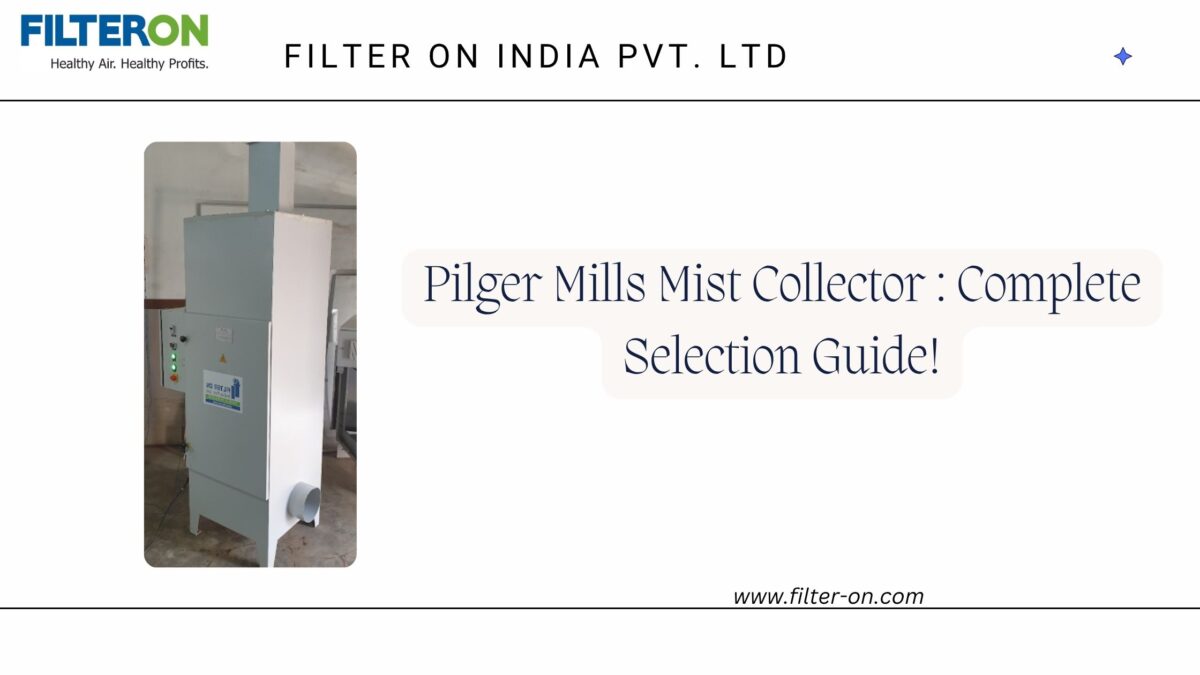
The Pilger Mills mist collector is essential for controlling oil mist generated during pilger mill operations. This mist contributes to a polluted work environment, exposing workers to serious health risks, including respiratory issues and irritation. Over time, prolonged exposure may lead to severe health conditions, such as cancer-related diseases.
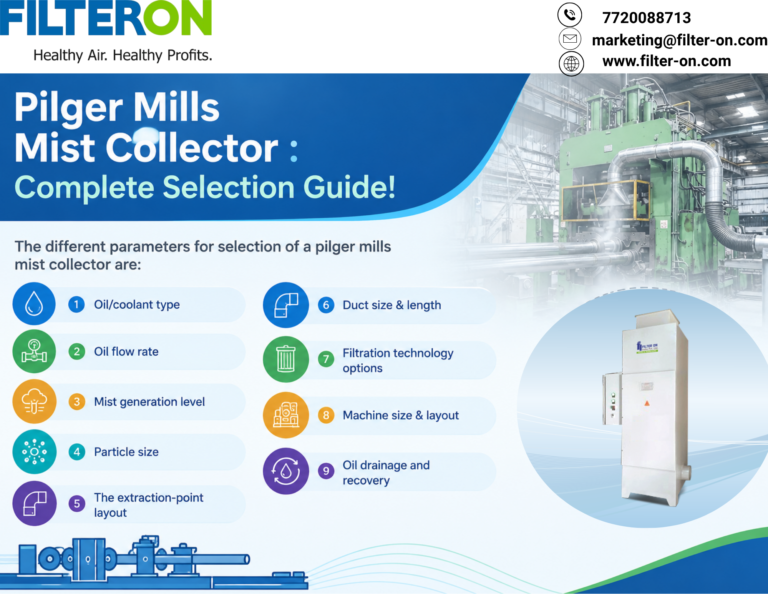
Selection Parameters: Pilger Mills Mist Collector:
For a Pilger Mill Mist Collector, the main selection parameters are
- Oil/coolant type – Oil/coolant type is more important in pillar mills because the rolling and lubricating oil characteristics are major factors to decide.
- Oil flow rate—Higher spray volumes can generate more mist, so oil flow rate is also a deciding parameter here.
- Mist generation level – It is based on rolling speed, lubrication method, and spray arrangement, so it is also an important factor in deciding mist collectors.
- Required airflow (m³/hr)—It is based on mill enclosure/working area and extraction points, as this is required to decide CMH for mist collector for pilger mills.
- Particle size – It determines the required filtration technology and efficiency, but here we recommend ESP (Electrostatic Precipitation) technology for better filtration and achieving the best efficiency.
- The extraction-point layout is essential for identifying the locations of the roll stand, lubrication zone, and other areas that generate mist. Understanding the exact points of mist generation is crucial for effective mist collection.
- Duct size & length – The bends and distance affect pressure loss to cover air flow pressure, so duct size and length are also deciding parameters for mist collectors.
- Filtration technology options include ESP (Electrostatic Precipitation), centrifugal, or multi-stage filtration, depending on the characteristics of the oil and mist. In this context, we recommend ESP because of its high efficiency and long-term suitability.
- Machine size & layout – It’s another determining factor. Important for mounting and routing.
- Oil drainage and recovery- They are beneficial in applications where significant oil is collected. ESP-based mist collectors, such as the Filter ON Pilger Mills Mist Collector, offer a distinct advantage for effective oil recovery.
Health Risks In Pilger Mills:
Workers can be exposed to oil mist through skin contact, inhalation, or ingestion. According to many health experts, most occupational exposure occurs through skin contact. Oil mist is harmful, but it is often contaminated with other chemicals that make it even more toxic to workers.
Long-term exposure to oil mist has been associated in studies with a higher risk for some cancers. Other health problems linked to exposure include:
- Contact Dermatitis / Photosensitive Allergy Dermatitis
- Bronchial asthma
- Lipoid pneumonitis
The symptoms of high oil mist concentration are
- Breathlessness
- Eye irritation Skin irritation
- Nausea and vomiting
- Heat
- Fast Heartbeat
- Burning sensation in the mouth, throat, and stomach
- Runny Nose
- Bronchitis
- Pulmonary fibrosis
- Lung neoplasm
- Benign and malignant neoplasms of the scrotum
How does ESP help in removing mist from Pilger Mills?
A cold-rolling Pilger Mill generates a massive amount of high-density oil mist and heat-generated smoke due to the application of large volumes of lubricants or metalworking fluids that reduce friction and dissipate extreme heat. An Electrostatic Precipitator (ESP) is employed for effective extraction of this fine mist, utilizing electric fields instead of physical mesh barriers. This innovative design enhances efficiency and prevents clogging, a common issue associated with standard fabric or cartridge filters.
Key Benefits of Using an ESP Based Pilger Mill Mist Collector
- Captures Sub-Micron Fumes: Effective in capturing ultra-fine organic vapors and smoke from pilgering, with particle sizes ranging from 0.01 to 0.1 microns.
- No Clogging or Filter Saturation: ESP plates are washable and reusable, avoiding issues like pressure drops and high replacement costs common with standard filters.
- Dual Value (Oil Recovery): Collected oil can be filtered and recycled, contributing to cost savings on raw materials.
- Constant High Airflow: The absence of physical barriers minimizes pressure drop, leading to significant energy savings in fan operation.
If your Pilger Mills machines operate without proper oil mist control, efficiency is being lost daily.
Evaluate your setup or consult an expert like Filter ON India to select the right system as per requirement, budget and scope. Contact us to learn more….
Frequently Asked Questions:
1. What are the different parameters for selection of Pilger mills mist collectors?
Ans: The different parameters for selection of a pilger mills mist collector are Oil/coolant type, Oil flow rate, Mist generation level, Particle size, The extraction-point layout, Duct size & length, Filtration technology options, Machine size & layout, Oil drainage and recovery.
2. How ESP based Pilger Mills Mist Collectors work?
Ans: A cold-rolling Pilger Mill produces a massive amount of high-density oil mist and heat-generated smoke from the use of large volumes of lubricants. To effectively extract this fine mist, an Electrostatic Precipitator (ESP) is utilized, which employs electric fields to enhance efficiency and prevent clogging, unlike traditional fabric or cartridge filters. here.
3.What health issues can be caused by mist from pilger mills?
Ans: The major health issues are contact Dermatitis / Photosensitive Allergy Dermatitis, Bronchial asthma,Lipoid pneumonitis.