

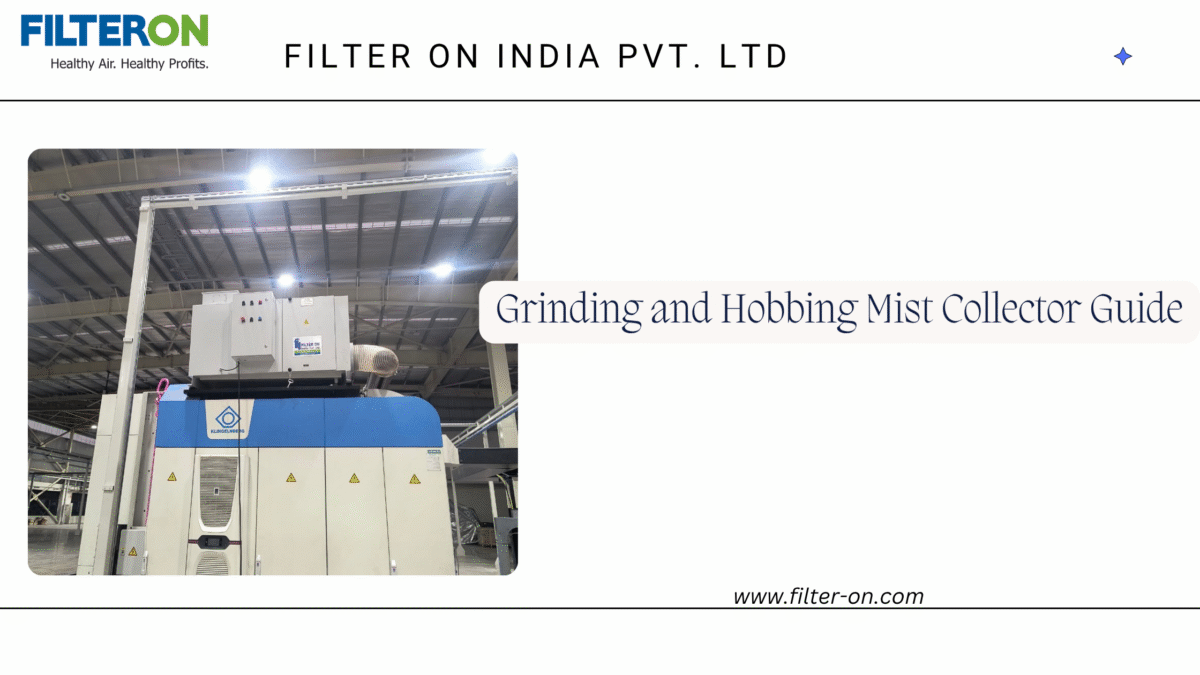
How to Choose the Right Oil Mist Collector for Gear Grinding & Hobbing Machines?
For gear grinding and gear hobbing machines, an gear grinding and hobbing mist collector is essential because mist flows everywhere due to the continuous operation of these machines, which can cause serious health problems for workers if the oil mist and fumes continue to spread everywhere. An oil mist collector for gear grinding/hobbing machines requires some of the details we can discuss here.
Here we discuss “How to choose the right oil mist collector for gear grinding & hobbing machines?”
The Problem:
Oil mist generated during gear grinding and hobbing creates a smoky environment where particles spread throughout the area. Workers inhale these particles, leading to issues such as nose and throat infections, eye irritation, and nausea. Prolonged exposure to this environment can exacerbate these health problems, potentially resulting in serious health issues for the workers.
Other issues include productivity loss, slippery surfaces that make the shop floor accident-prone and risky, and oil and dirt deposits that increase fire susceptibility. The spread of oil mist in the work environment leads to various health issues for workers, resulting in high absenteeism and further productivity loss. Additionally, oil mist exposure creates slippery surfaces that may cause accidents, and the presence of mist and oil raises the likelihood of fire.
Choosing the right Gear Grinding and Hobbing Mist Collector?
When you consider buying an oil mist collector for a gear grinding or gear hobbing application, you must consider airflow, machine type, oil mist area, and enclosure design before buying the oil mist collector. If your selection of these above parameters is slightly wrong, then the purchase of your oil mist collector will be costlier. For example, suppose you have wrongly calculated the CFM, i.e., airflow; then you will buy a lesser-capacity oil mist collector, which leads to oil mist problems, as it is due to not effectively capturing the mist and the filtration system’s lesser capacity, which ultimately has issues in system breakdown. This results in increased costs due to the need for greater filtration capacity, which can ultimately drive up expenses.
Key Factors to Consider: For Gear Grinding and Hobbing Mist Collector:
- Application Details: The application details are crucial for recommending a more suitable fume extraction system. It is essential to determine whether the application involves gear grinding or gear hobbing, as well as to identify the makes of the machines being used. This information is vital for understanding the system’s structure and developing appropriate solutions.
- Oil/Coolant Type: Oil or coolant type is a critical detail to look for, as whether they are using neat cutting oil or water-soluble coolant for machining purposes is a must-know thing as it impacts oil mist generation.
- Machine oil/coolant pressure (in Bar): Machine oil/coolant pressure is an important parameter as oil mist collector systems for CNC gear grinding and hobbing machines manage high-volume, fine-particle mist produced by neat oil. Particle size & density of oil mist generated depends on pressure of oil used. So, higher pressure applications would need better filtration.
- Type of enclosure: Fully/Partially: Enclosing machines during gear grinding and gear hobbing is essential for effective oil mist collection, as these high-speed processes generate substantial heat, oil mist, and metal particles. An enclosure acts as a protective barrier, preventing contaminant dispersion, safeguarding worker health, and ensuring machine precision. These details are required for correcting the CFM requirement for oil mist collectors.
- Cycle time for opening door/job loading/unloading: Cycle time between door openings plays an important role in deciding the airflow suction capacity. The more frequent the door openings, the more air changes of the machining chamber are needed to avoid the escape of fumes & mist from the door openings. It is important in the context of oil mist collectors for the gear grinding and gear hobbing machines, as it defines how much mist is generated during the cycle time. It is an important metric to consider when you choose the capacity of an oil mist collector.
- Individual Machining Chamber Dimensions (LxWxH): The individual machine dimensions are an important factor for oil mist collectors, as they are required to determine how much volume oil mist is generated from the machine. This is important to determine the area of oil mist and mist coverage.
- Size of Door Opening: Larger Size doors with frequent openings will need higher air flow suction capacity and vice versa.
- Depth of Cut: Higher depth of cut generates more heat and thus produces more fumes / mist.
- Cutting Chamber Size: The greatest working envelope (workpiece diameter, length, and module) that the machine can handle is referred to as the cutting chamber size in gear grinding and gear hobbing machines.
- Coolant Type: Flood/Micro mist: The type of coolant used whether flood type or micro mist is a crucial factor in gear grinding and hobbing processes. This is important because both types are used simultaneously, influencing mist exposure. From the perspective of an oil mist collector, understanding the coolant type is essential for efficient mist collection.
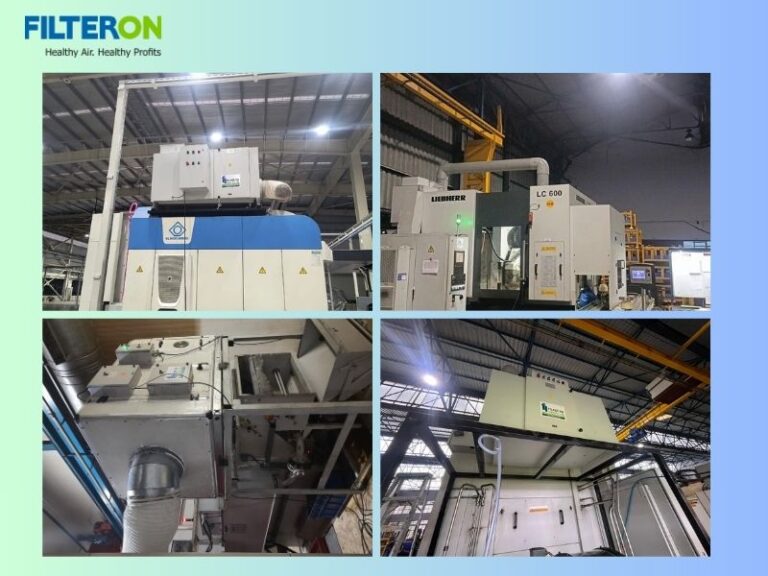
Solutions for Oil Mist in Gear Grinding and Gear Hobbing Mist Collector:
In gear grinding and hobbing applications to control the mist, there are various solutions available, but unlike media-based systems, ESP (Electrostatic Precipitation Technology)-based systems are very beneficial for a long-term perspective.
How ESP works for Gear Grinding and Hobbing Mist Collector:
Oil mist collectors use electrostatic precipitators (ESPs) to effectively remove small, sticky oil particles and smoke. The particles are charged using a high-voltage field, which draws them to grounded plates with an opposing charge. Particles are charged by an ionizer and then captured by a collector cell. High efficiency, minimal pressure loss, and the benefit of reusable filters are all provided by this technique.
Advantages:
- Zero Replacement Cost (Washable, Reusable filters)
- Low Operational cost (Low Power Consumption)
- High Efficiency of Filtration for very fine submicron solid / liquid particles in machining mists.
Role of ESP in Gear Grinding & Gear Hobbing Mist Collector:
Electrostatic precipitators (ESPs) are high-efficiency air pollution control systems used in gear grinding and hobbing to absorb oil mist, vapors, and particles produced by plain oil coolants. ESPs play a key role in maintaining high-precision gear production. At the same time, they help reduce maintenance efforts by keeping the working environment clean and limiting the buildup of contaminants on machines.
- High Efficiency in Oil Mist Removal:
ESPs are highly effective, typically removing around 95–99% of fine, sub-micron oil mist and smoke generated during gear cutting, shaving, and grinding processes. - Worker Safety and Health:
By controlling the spread of airborne mist, ESPs help reduce common issues faced by operators, such as respiratory discomfort, bronchitis, and skin irritation. - Protection of Sensitive Equipment:
Fine particles in the air can settle on CNC panels and electronic components. ESPs help prevent it, which in turn reduces the chances of equipment failure and lowers maintenance requirements. - Cleaner Workplace Environment:
They also help avoid oil fumes settling on floors, walls, and ceilings. This keeps the shop floor cleaner and reduces the risk of slips or accidents. - Oil Recovery and Reuse:
In many industrial setups, the oil collected in ESP systems can be drained and used again, which helps reduce coolant wastage and keeps operating costs under control.
Filter ON India has been a prominent player in the Indian industrial air filtration market for the last 43 years, powered by ESP technology-based products, especially for welding, oil mist, dust collection, and kitchen dry scrubber systems
Frequently Asked Questions:
Why is an oil mist collector needed in gear grinding and hobbing?
Because these machines run continuously and generate fine oil mist that spreads across the shop floor, making the air unhealthy for worker.
What happens if the oil mist collector capacity is not correct?
If the sizing is wrong, the system won’t capture mist properly, which can lead to higher maintenance and additional costs later.
Does coolant type really affect oil mist generation?
Yes, the type of coolant whether neat oil or water-soluble changes how much mist is produced during machining.
Can collected oil from ESP systems be reused?
In many cases, yes. The collected oil can be drained and reused, which helps reduce wastage and saves on operating costs.