Categories
Blogs

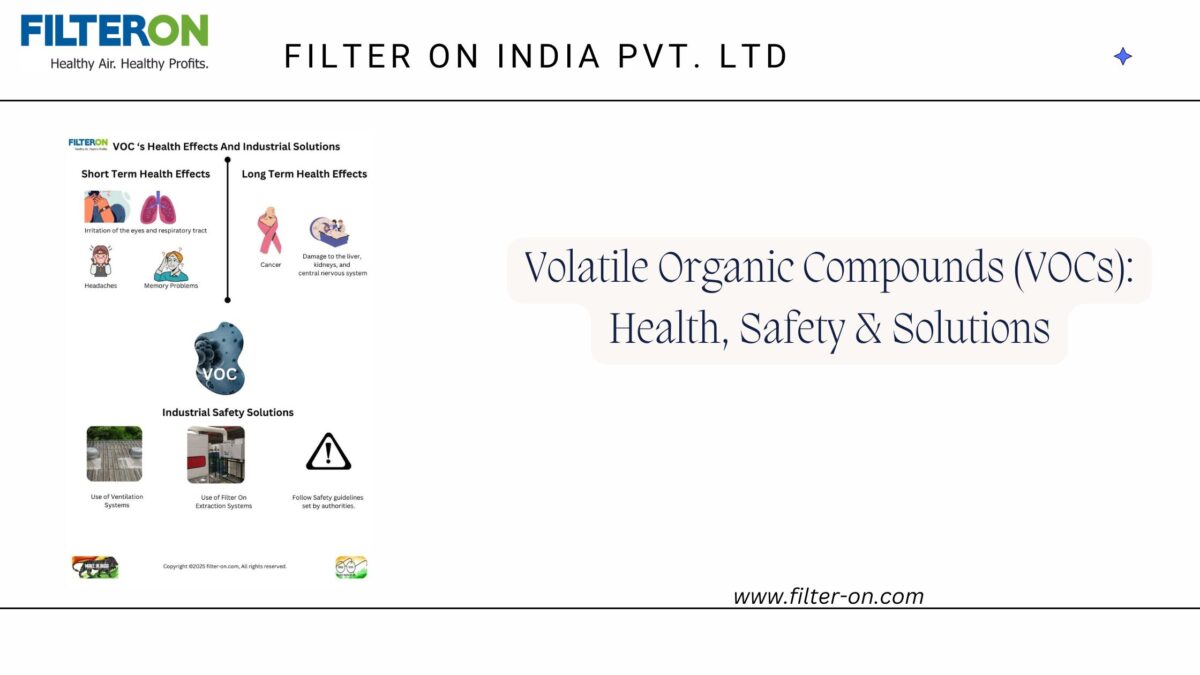
Volatile Organic Compounds (VOCs): Health, Safety & Solutions

Clearing the Air: Understanding Volatile Organic Compounds (VOCs) – Examining Pollution, Health Impacts, Safety Limits, and Industrial Solutions for Risk Mitigation

When we think about pollution, we have thoughts about its various sources and main pollutants, such as transportation, industrial pollution, CO2, SO2, and volatile organic compounds (VOCs). VOCs are small organic compounds that are present in the air and play a vital part in air pollution. We are here to discuss the VOC, its impact on health, safety limits, and solutions to restrict the risks associated with VOCs.

What are VOCs?

Volatile organic compounds (VOCs) are a group of chemicals that highly vaporize into the air. Chemicals like benzene, ethylene glycol, methylene chloride, tetrachloroethylene, toluene, xylene, and 1,3-butadiene. These VOCs are themselves harmful, and some of them combine and form other pollutants as well.

Common products where VOCs are mostly present:

  • Paints, paint strippers, and other solvents
  • Wood preservatives
  • Aerosol sprays
  • Cleansers and disinfectants
  • Moth repellents and air fresheners
  • Stored fuels and automotive products
  • Hobby supplies
  • Dry-cleaned clothing

VOCs as pollutants:

Volatile organic compounds (VOCs) are a group of pollutants that are responsible for air pollution. Some of the sources of VOCs are as follows:
Volatile Organic Compounds (VOCs): Health, Safety & Solutions

Natural Sources-

Volatile organic compounds Natural sources are as follows:

  • Plants: Many plants release harmful chemicals, and some can even absorb them.
  • Forest fires: Natural forest fires are a source of VOCs.
  • Anaerobic moors: Anaerobic moors processes are a source of VOCs.
  • Cattle farms: Cow manure is a volatile source of methane, a potent greenhouse gas.
  • Anything burning: Anything that burns can be a source of VOCs.

Some of the other natural sources include volcanoes and fermentations.

Artificial Sources-

Artificial, man Made sources of VOCs include fuel production, distribution, and combustion, with the largest source being emissions from motor vehicles due to either evaporation or incomplete combustion of fuel and from biomass burning.

Volatile organic compounds (VOCs) are industrial solvents, fuel oxygenates, and by-products from water treatment. They are often found in petroleum fuels, hydraulic fluids, paint thinners, and dry cleaning agents.

VOCs can come from industrial sources such as:

  • Burning fossil fuels
  • Power generation
  • Manufacturing chemicals
  • Crude oil processing
  • Some metal production processes

Other sources of VOCs include:

  • Gasoline, fuels, and solvents
  • Paints, stains, strippers, and finishes
  • Pesticides
  • Personal care products
  • Aerosol sprays
  • Cleaners and room deodorizers
  • New cabinets, furniture, and beds
  • New carpets, rugs, and wood floors

According to Energy Education, a major contributor to VOCs is the evaporation of hydrocarbon-rich liquids. These include:

  • Gasoline from car tanks or refueling stations
  • Industrial solvents such as oil-based paint
  • Barbecue starter fluid
  • Cleaning products

Health Effects of Volatile Organic Compounds (VOCs)

The health effects of VOCs are as follows:

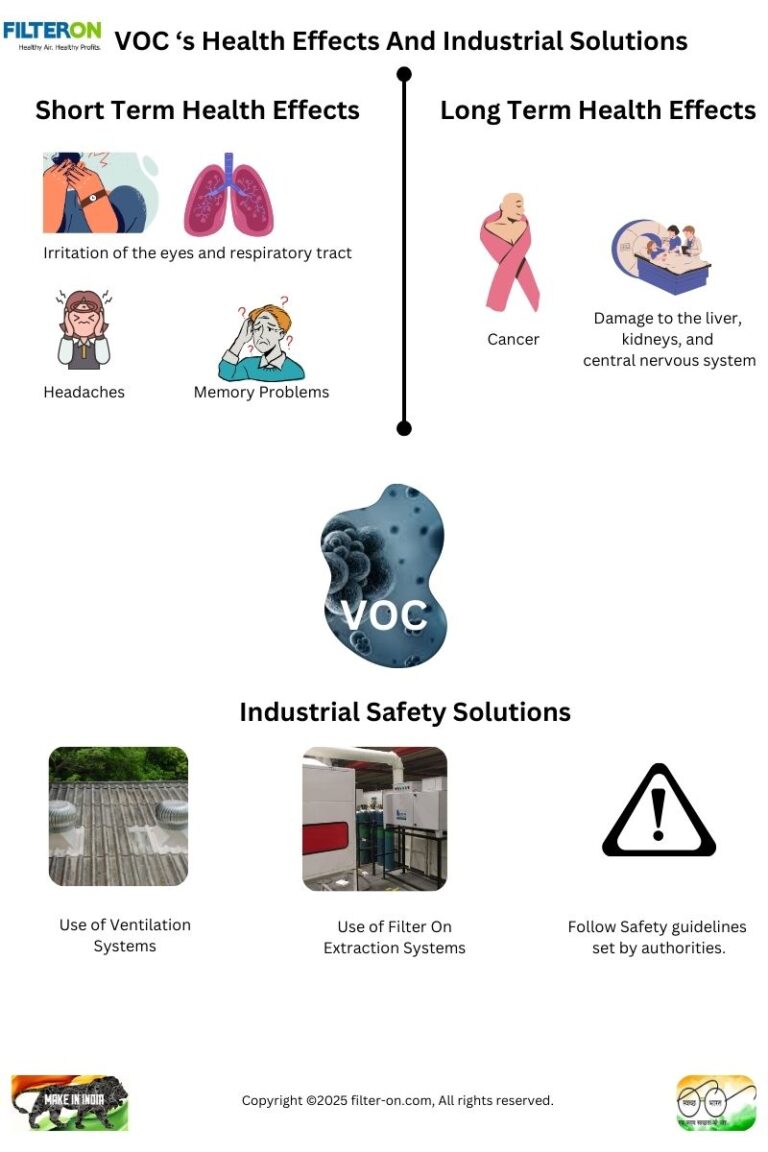
The health effects of VOCs on industrial workers and general people are categorized by short-term exposure and long-term exposure limits. Short-term exposure effects on health are immediate, and they have been for short periods of time, may be a few hours or a few days, whereas long-term health effects can be long-term exposure, may be a few years, to permanent effects on health. Both are categorized as under.

Short-term:
Short-term exposure to various VOCs may cause:

  • Irritation of the eyes and respiratory tract
  • Headaches
  • Dizziness
  • Visual disorders
  • Memory problems

Long-term:
Long-term exposure to various VOCs may cause:

  • Irritation of the eyes, nose, and throat
  • Nausea
  • Fatigue
  • Loss of coordination
  • Dizziness
  • Damage to the liver, kidneys, and central nervous system
  • Cancer

Industrial Safety Limits for VOCs

Safety Guidelines for Industries by CPCB With respect to VOC exposure

The industries can look more closely at the following aspects for the control of VOCs:

  • Closed handling system for chemicals.
  • Improved solvent recovery through the use of some special condensers and subcooling systems.
  • Mechanical seal for chemical handling pumps.
  • LDAR system – Venting of storages with trap receiver and condenser.
  • Training for the laborers and staff.
  • Proper system of loading and unloading of solvents.
  • Proper solvent recovery systems.
  • Work environment monitoring with respect to VOC has to be conducted and compared with the Factories Act’s occupational health standards.
  • All the emissions emitting sources are to be channeled through ducts to a common conduit, and after advanced condensers and/or scrubbing with relevant or proper scrubbing, the treated emissions are to be let into the air.

Solutions for VOC exposure in industrial environments:

Solutions for VOC exposure in industries are as follows:

Proper Ventilation Measures:

Proper ventilation measures, such as LEV (local exhaust ventilation), must be installed in high-exposure areas of industries for worker safety.

Use of Extraction Systems:

Using extraction systems like Filter On India’s Clean Air Solutions in welding fumes solutions, oil mist extraction and dust collection solutions like welding fumes extractors, oil mist collectors, dust collectors, downdraft tables, and ESP filtration systems with HEPA must be used to control VOC exposure in industrial environments.

Follow guidelines set by authorities.

With regards to worker safety, industries must follow guidelines set by different authorities, such as OSHA, EPA, and CPCB, to control VOC exposure in industries.

Industrial safety limits for VOCs are provided by OSHA,EPA, ACGIH, and in the Indian context, CPCB.

As per OSHA, ACGIH, and NIOSH, the permissible exposure limits for VOCs are as follows-

Exposure Limits
OSHA (PEL)for general industry: 50 ppm (240 mg/m3) TWA; Skin for the Construction Industry: 50 ppm (240 mg/m2) TWA; Skin for Maritime: 50 ppm (240 mg/m2) TWA; Skin
ACGIH (TLV)20 ppm; Appendix A3: Confirmed Animal Carcinogens with Unknown Relevance to Humans
NIOSH (REL)5 ppm (24 mg/m2) TWA
NIOSH (IDHL)700 ppm

The OSHA standards for VOCs can be read here.

Another example of regulations relating to VOC safety includes the EPA’s regulation 40 CFR 59. This federal regulation, “National Volatile Organic Compound Emission Standards for Consumer and Commercial Products,” targets overseas manufacturers and importers of certain products and seeks to ensure that such parties remain in compliance with VOC emission standards.

In the Indian context, the CPCB (Central Pollution Control Board) has set the permissible exposure limits for pollutants, so for VOCs, its limits are as follows:

Moreover, there is no legislation for VOC in ambient air in India. As per the National Ambient Air Quality Standard (NAAQS) of India, benzene is the only VOC whose standard has been prescribed as 5 μg/m3 since November 2009.

Visit  blogs to learn more about the critical features of clean air system design and air pollution control systems created by Filter On India.
Filter On India has been working towards “Mission Zero Pollution” for the last 40+ years as a clean air solutions partner for industries. We specialize and have expertise in welding fumes, oil mist, coolant mist, dust collection, soldering, laser marking, laser cutting, plasma cutting, fumes in fastener manufacturing, ball point tip manufacturing, oil quenching, kitchen fumes, etc. Filter On has 70+ clean air solutions, so you can contact us for more information about our solutions. You can reach us through the web or visit us at our corporate office at Pune, or mail us at : marketing@filter-on.com

Facebook
Twitter
LinkedIn
Categories
Blogs

Understanding CO2: Pollution, Impact And Proactive Solutions.

Understanding CO2: Pollution, Impact And Proactive Solutions.

In today’s world, air pollution is a huge and serious issue. Alarming sea levels and the effects of global warming are seen everywhere. Carbon dioxide (CO2) is a major pollutant among all pollutants. It’s effects on the health and environment are problematic in nature. When we talk about industrial pollution, it is one of the problems as well, so in this article, we’ll discuss CO2 and the role of CO2 in air pollution. Its impact on industrial workers as well as industries, the environment, preventive measures, compliance, etc.

What is CO2?

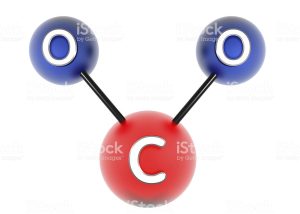
Carbon dioxide is a chemical compound with the chemical formula CO2. It is made up of molecules that each have one carbon atom covalently double-bonded to two oxygen atoms.

CO2 as a Pollutant

Carbon dioxide is a major pollutant in air pollution. When talking about air pollution, this greenhouse gas has a major portion in it.

Sources of CO2 Pollution in the Industrial Indoor Work Environment

There are numerous sources of CO2 pollution. We are here discussing CO2 and its effects on the workplace environment and workers health.

There are mainly four types of sources of CO2 often seen in the indoor industrial environment.

Respiration from employees.
Burning of fuels
Industrial Operations
Goods Transportation

Respiration from Employees

In a close work environment, mostly in offices, CO2 is mostly generated by respiration among the employees.

Burning of Fossil Fuels

The burning of fossil fuels for the operation of machinery is another way of generating CO2, and if there is low ventilation, the CO2 can be hazardous to the workers.

Industrial Operations-

Industrial operations, i.e., processes like welding, cutting, and brazing of metals, generate CO2 because fumes from these processes are more hazardous to the health of the workers. These processes produce more CO2, and without proper ventilation and fume collection systems, in most of the industries, workers face various health issues due to CO2 pollution.

Goods Movement-

Goods movement or transportation in a closed environment where trucks and cranes are used for goods movement in large premises generates CO2 generated through vehicles, which is harmful for the workers and employees who used to work there.

Thus, CO2 as a pollutant plays a major role in industrial indoor air pollution.

Impact of Carbon Dioxide (CO2) on Health:
Short-Term Health Effects:
Exposure to high carbon dioxide levels can cause:

Suffocation by displacement of air: The suffocation-exposed person has no warning and cannot sense the oxygen level is too low, so it leads to a breathing issue.

Incapacitation and unconsciousness: At high concentrations, carbon dioxide can cause unconsciousness and respiratory arrest within one minute.

Headaches: Excessive amounts of carbon dioxide inhalation can cause headaches.

Vertigo and double vision: Carbon dioxide exposure can cause vertigo and double vision. At high levels of exposure, the carbon dioxide itself can cause vertigo, dizziness, nausea, and other symptoms like double vision.

Inability to concentrate: High exposure levels of CO2 lead to concentration problems while working; suffocating environments can cause an inability to concentrate, which results in productivity loss.

Tinnitus: According to one study, chronic tinnitus is related to multisensory environmental hypersensitivity, including CO2 thresholds. Another study reports that tinnitus has been reported in hearing loss secondary to carbon monoxide poisoning.

Seizures: Carbon dioxide (CO2) can increase brain excitability, which can lead to spontaneous seizures.

Breathing in high amounts of carbon dioxide may be life-threatening.

Touching liquid carbon dioxide can cause frostbite or blisters.

Carbon dioxide can cause frostbite when anyone is in contact with solid CO2 (dry ice) and vapors off-gassing from dry ice.

These frostbite blisters on the skin may begin to feel warm—a sign of serious skin involvement. If you treat frostbite with rewarming at this stage, the surface of the skin may appear mottled. And you may notice stinging, burning, and swelling. A fluid-filled blister may appear 12 to 36 hours after rewarming the skin.

Long-Term Health Effects: Prolonged exposure to carbon dioxide may cause:

Changes in bone calcium-induced respiratory acidosis induced by an elevated carbon dioxide (CO2) environment should provoke hypercalciuria with related total body and subsequent bone calcium losses. often leads to osteoporosis.

Changes in body metabolism: In the human body, carbon dioxide is formed intracellularly as a byproduct of metabolism.

Levels of CO2 Exposure to Health

Safe exposure limits for carbon dioxide (CO2):

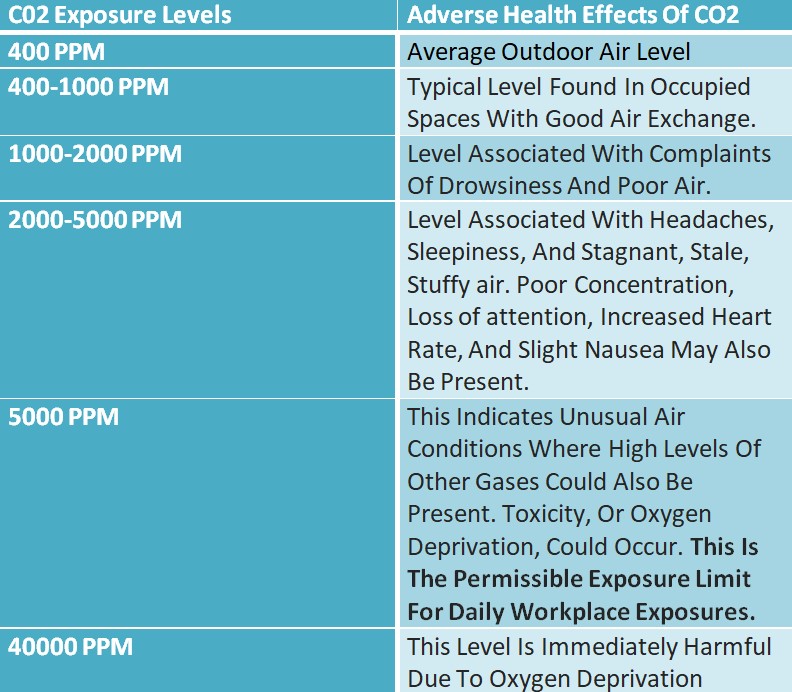
According to the US Health Department, carbon dioxide is not generally found at hazardous levels in indoor environments. The MNDOLI has set workplace safety standards of 10,000 ppm for an 8-hour period and 30,000 ppm for a 15-minute period. This means the average concentration over an 8-hour period should not exceed 10,000 ppm, and the average concentration over a 15-minute period should not exceed 30,000 ppm. It is unusual to find such continuously high levels indoors and extremely rare in non-industrial workplaces. These standards were developed for healthy working adults and may not be appropriate for sensitive populations, such as children and the elderly. MDH is not aware of lower standards developed for the general public that would be protective of sensitive individuals.

In the Indian context, the exposure limits for CO2 are as follows: CO2 < 1000 PPM (home) < 5000 PPM (workplace-short duration).

Proactive Solutions for CO2 Emissions in Industries


Measure your CO2 levels in industries.
You can measure CO2 levels at your workplace by using a CO2 sensor. The most common type of sensor is the non-dispersive infrared (NDIR) sensor. This sensor measures infrared light in a sample of air. NDIR sensors are popular because they have a long life, are fast, and have low cross-sensitivity to other gases. They can measure CO2 concentrations with high accuracy across a wide range of volumes. The measuring unit detects the CO2 concentration and converts it into a digital display.

Use renewable energy solutions.
You can use renewable energy solutions for CO2 reduction from traditional energy sources. Sources like solar energy and wind energy can reduce the carbon footprint and make industries self-sustainable in the long run.
Use ventilation solutions.
Using ventilation solutions such as local exhaust ventilation, an adequate amount of air flow through windows, and proper placement of machines that are responsible for CO2 generation with effective measures can reduce the carbon footprint in industries.

Use extraction solutions.
Clean air solutions like fume extraction, oil/mist collectors, dust collection systems, and laser cutting extraction solutions can reduce CO2 exposure in industries, which helps workers get proper ventilation at work and can have a positive impact on their productivity.

Filter On India has been working towards “Mission Zero Pollution” for the last 40+ years as a clean air solutions partner for industries. Filter On has 70+ clean air solutions, so you can contact us for more information about our solutions. You can reach us through the web or visit us at Pune, Delhi, Bangalore, or Chennai locations.

Categories
Blogs

Breathable Workspaces: Understanding PM 2.5 and PM10 Pollution

Breathable Workspaces: Understanding PM 2.5 and PM10 Pollution, Knowing Safety Limits, and Implementing Solutions for Worker Health

Today, air pollution is a very sensitive subject for everyone. In every country, cities, and now small villages, are also affected by air pollution due to various pollutants. PM2.5 and PM10 are two of the major pollutants. In industrial environments, PM2.5 and PM10 are present due to various industrial processes. In this article, we are discussing PM2.5 and PM10 as pollutants, their impact on industrial workers, safety and solutions to overcome pollution from them, and government norms and regulations about PM2.5 and PM10 in an industrial context.

What are PM 2.5 and PM 10?

Particulate matter (PM) is a fine, microscopic matter suspended in air or water. PM2.5 and PM10 are the two types of particulate matter.

What is PM2.5?

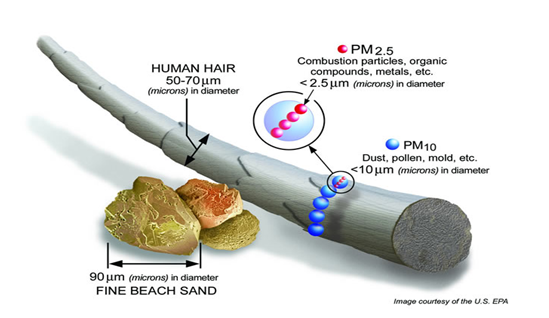
Particulate Matter (PM) 2.5 is a very small particulate matter with a microscopic size of 2.5 or smaller.

What is PM10?

Particulate Matter (PM) 10 is a small particulate matter with a diameter of a microscopic size of 10 or smaller.

PM2.5 and PM10 as pollutants

PM2.5 and PM10 are small particulate matter that is totally microscopic, so they are inhaled by humans.

PM2.5 Sources

Natural Sources:

>> Forest Fires
>> Volcanic Eruptions
>> Earthquakes

Artificial Sources

Industrial Sources :

Industrial sources include paper pulp industries, oil refineries, brick kilns, power plants, municipal waste treatment plants, industrial fossil fuel burning, and gasoline sources such as sulfur dioxide and nitrogen oxide.

Household Sources :

>> Construction Sites
>> Smoking
>> Cooking, Frying, and Not Maintaining Kitchen Chimneys
>> Wood Burning
>> Biomass Burning

Emissions

>> Emissions from Vehicles

PM10 Sources :

There are various sources of PM10 pollution.
The natural sources include sea salt, dust, etc., whereas man-made sources are as follows:
  • smoke, dust, and dirt from unsealed roads, construction, landfills, and agriculture

  • pollen

  • mold

  • smoke from wildfires and waste burning

Industrial Sources

>> materials handling
>> crushing and grinding operations
>> power generation

In the home, PM10 comes from many sources, some of which are as follows:

>> outdoor sources leaking in through spaces around doors and windows

>> stoves

>> space heaters

Apart from these sources, some of the industrial processes also produce PM2.5 and PM10.

Welding :

Welding is a general process that is carried out in most manufacturing industries. During the welding process, PM2.5 and PM10 are generated when hot metal vaporizes, cools, and condenses into small, solid metal particles. Welding aerosols can be coarse (PM 2.5–10) or fine (PM 0.1–2.5). Welding produces visible smoke that contains harmful metal fumes and gas by-products. Welding workers are exposed to significant amounts of the metal fume PM2.5 during the welding process.

Plasma Cutting-

Plasma cutting generates the highest concentrations of PM2.5. Most aerosols generated during plasma arc cutting are PM 2.5. The fumes and gases generated by plasma cutting depend on whether the cutting is dry or wet.

Some of the other processes are also responsible for PM2.5 and PM10 generation, like diesel exhaust.

Health Effects of PM 2.5 and PM 10.

Particulate Matter (PM) 2.5 and 10 have very serious health effects on humans, mainly those who are most in contact with them. In industries, these pollutants are generated from various industrial processes such as welding, brazing, cutting, etc. So the adverse health effects of these pollutants are as follows:.

Short-term health effects of PM10 can include:

>> Difficulty breathing
>> Coughing
>> Eye, Nose, and Throat Irritation
>> Chest tightness and pain
>> Fatigue
>> General Respiratory Discomfort

Long-term exposure to PM10 can cause more serious health concerns, such as:

>> Lung tissue damage
>> Asthma
>> Heart Failure
>> Cancer
>> Adverse birth outcomes
>> Chronic obstructive pulmonary disease (COPD)
>> Premature death

Health Effects of PM2.5

>> Short-Term Health Effects of PM 2.5
>> Irritation of the throat and airways
>> Coughing
>> Breathing Difficulty

Long-Term Health Effects of PM 2.5

>> Heart and lung disease
>> Bronchitis
>> Emphysema
>> Nonfatal heart attacks
>> Irregular heartbeat
>> Asthma and more intense flare-ups
>> Decreased lung function
>> Early death

Safe Limits for PM 2.5 and PM 10.

There are two types of absorption limits for PM 2.5 and PM 10, as follows:

>> General (Ambient Air) Absorption Limits for PM2.5 and PM 10
>> Industrial Processing Absorption Limits for PM2.5 and PM 10

General (Ambient Air) Absorption Limits for PM2.5 and PM 10

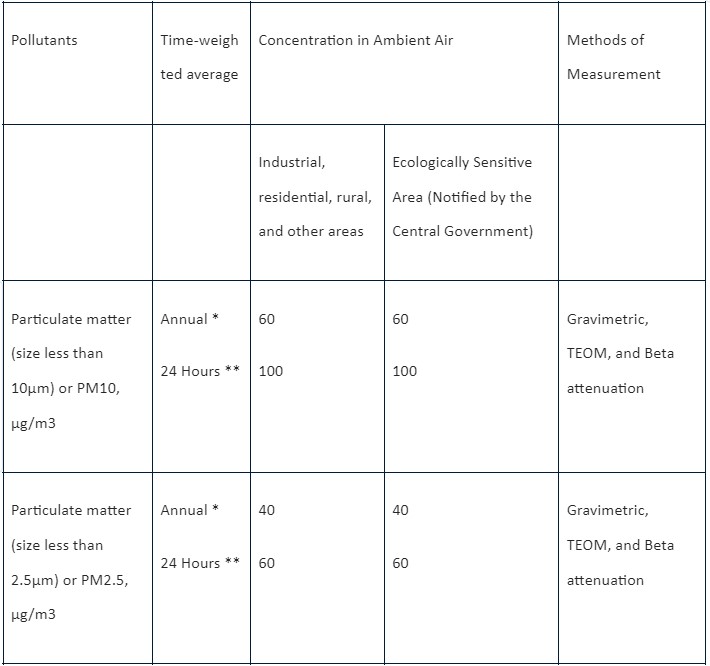
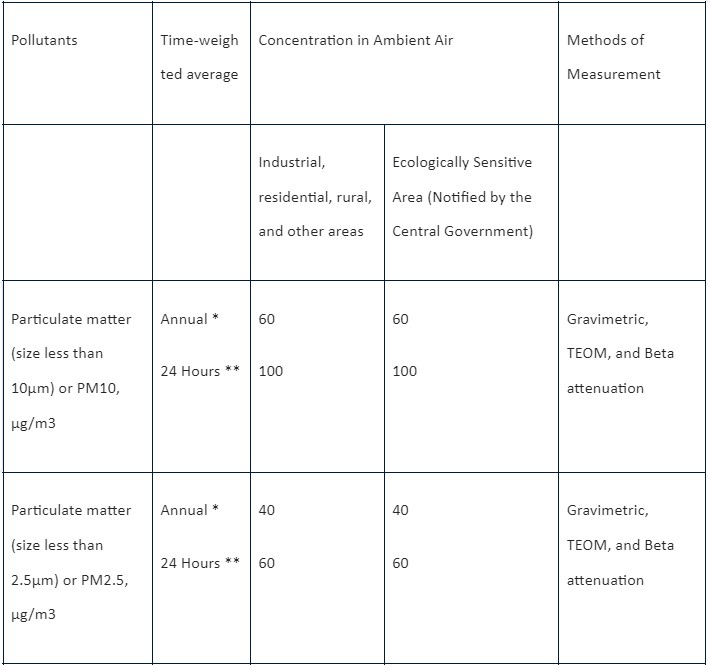
As per CPCB India’s Central Pollution Control Board’s norms, the general (ambient air) absorption limits of PM 2.5 and PM 10 are as follows:

Industrial Process Absorption Limits for PM 2.5 and PM 10.

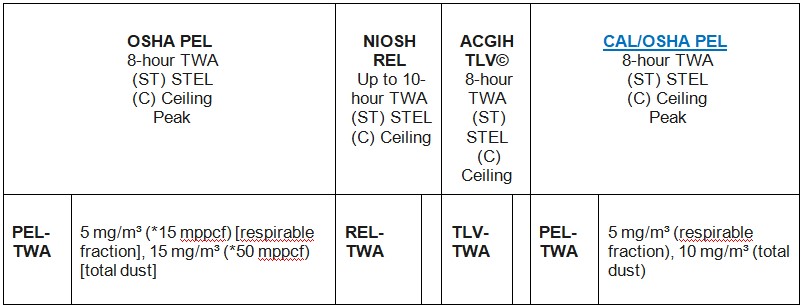
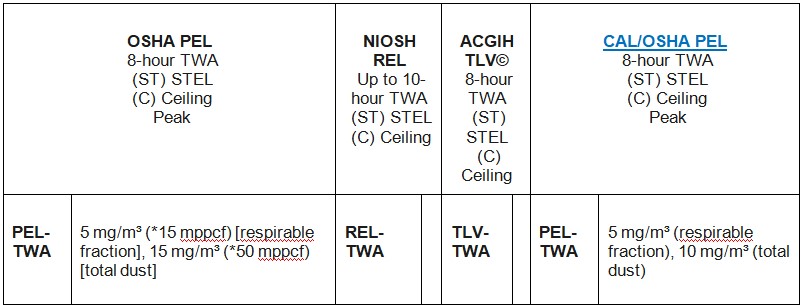
The industrial process absorption limits for PM2.5 and PM10 as per OSHA standards are as follows:

Solutions to PM 2.5 and 10 in the Industrial Environment

Many countries seek to reduce PM2.5 and PM10 air pollution. For example, in 2019, India joined the United Nations Climate and Clean Air Coalition with the stated goal of reducing particulate matter pollution by 20 to 30 percent by 2024. The country launched the National Clean Air Program in mid-2019.

Solutions on PM 2.5 and PM 10 for Industries

Use Eco-Friendly Process Materials: Industries must use eco-friendly process materials for their processes, such as in welding, where we must use water-based fluxes or electrode coatings, which can reduce the environmental impact of welding. These materials help reduce the fumes generated and waste produced during the welding process.

Use Industrial Air Filtration Systems: Industrial air filtration systems such as welding fume extractors, oil mist collectors, laser marking fume extractors, soldering fume extractors, and dust collectors must be used for air filtration in an industrial work environment to reduce the impact on workers of PM 2.5 and PM 10.

Use Monitors for Measurement of PM2.5 and PM10 Pollution in Industries: Use PM2.5 and PM10 monitors for measurement of the severity of workers health.

Use PPE Equipment While Working: Use personal protective equipment like masks, helmets, hand gloves, and PPE attire while working to reduce PM 2.5 and PM 10 exposure.

Reduce Burning Fossil Fuels: Reducing fossil fuel use and switching over to renewable energy sources can reduce the exposure to PM2.5 and PM10 in industries because the burning of fuels is a major source of PM2.5 and PM10 pollution.

Reducing the use of wood burning: reducing the burning of wood is the best solution to reducing PM2.5 and PM10 pollution.

Filter On India has been working towards “Mission Zero Pollution” for the last 40+ years as a clean air solutions partner for industries. Filter On has 70+ clean air solutions, so you can contact us for more information about our solutions. You can reach us through the web or visit us at Pune, Delhi, Bangalore, or Chennai locations.